
Product Page Title
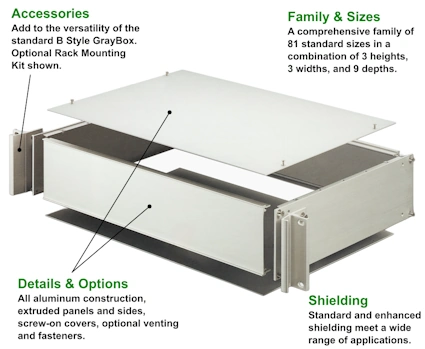
Product Features
Lorem ipsum dolor sit amet, consectetur adipiscing elit. Ut elit tellus, luctus nec ullamcorper mattis, pulvinar dapibus leo.
Product Variations

Menu Item
Menu Item
Menu Item
Product Price
Menu Item
Product Specifications
Lorem ipsum dolor sit amet, consectetur adipiscing elit. Ut elit tellus, luctus nec ullamcorper mattis, pulvinar dapibus leo.
Accessories
-
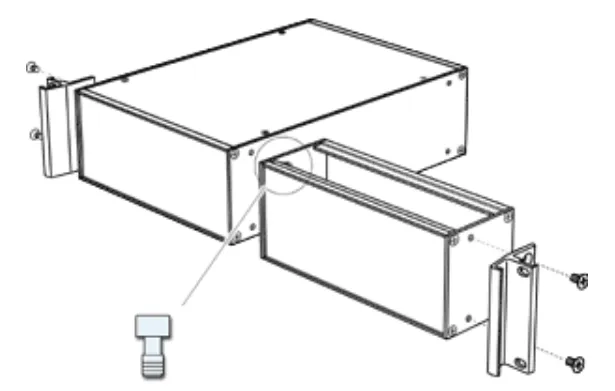
Coupling Screws
-
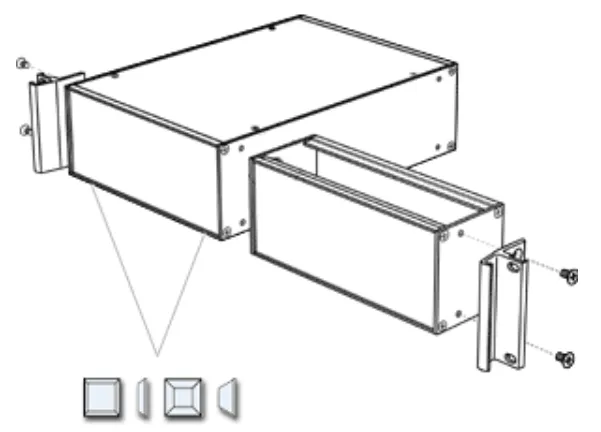
Non-skid Feet
-
Rack Mount Panels for MicroPak Enclosures
-
How Aluminum Enclosures Manage Heat Dissipation and Signal Stability in Power Systems
Modern power systems inherently generate heat and electromagnetic noise through high frequency switching, power conversion, and continuous operation. As system density increases, thermal and electromagnetic effects become tightly coupled, directly influencing temperature stability, signal integrity, and overall system reliability. These interactions are no longer secondary considerations. They define system performance under load. The enclosure establishes…
-
Managing EMI in High-Performance Electronics for Power and Timing Systems
High-performance electronics used in power delivery and timing systems operate in demanding environments where electromagnetic compatibility margins are increasingly constrained. As switching frequencies rise and system architectures become denser, EMI performance becomes increasingly dependent on enclosure design for maintaining signal integrity, timing stability, and power system reliability. A well-engineered EMI shielded enclosure is a defining factor in…
-
Designing PCB Enclosures That Survive Verification, Validation, and Clinical Use
Medical device development is often driven by electronics performance, leading many teams to design the printed circuit board (PCB) first and address the enclosure later. While this approach may accelerate early prototyping, it introduces risk as products move toward verification, validation, regulatory testing, and clinical use. PCB enclosures are more than protective housings; they define…
-
How Machinery OEMs Cut Rebuild Time with Modular Enclosure Platforms
Machinery OEMs operate in a constant cycle of refinement. A machine platform that begins as a single configuration often evolves into multiple variants as new customer requirements emerge. Control layouts change, I/O requirements expand, power density increases, and new sensors or subsystems are integrated. While these changes expand product capabilities, they often expose a persistent…
-
Designing a Scalable Control Panel Enclosure for Manufacturing and Automation Systems
Control panels are rarely one-and-done. In manufacturing and automation environments, systems expand as throughput increases, processes change, or new equipment is added. When a control panel enclosure is designed as a fixed, one-off build, every change introduces friction: redesigning, fabrication delays, QA risk, and downtime. Modular enclosure platforms solve this problem by giving engineers a repeatable foundation…
-
The Benefits of Enclosure Production Repeatability
Many hardware engineering teams face a common dilemma: the need to create custom electronic prototype enclosures quickly, while still building something that won’t potentially require a complete redesign when production begins. Too often, teams find themselves trapped in a cycle where each product iteration forces them back to square one with their enclosure. Before long,…
-
From Specification to Reality: Why OEMs Benefit from Enclosures Engineered to Meet NEMA & IP Ratings
When OEMs begin planning for environmental protection, the conversation often starts with NEMA and IP ratings such as “We need IP67.” “We need a NEMA 4X enclosure.” These ratings serve as helpful benchmarks, but they describe only the required protection level, not how to design or build an enclosure that achieves performance in actual operating conditions. Products…
-
Passive vs. Active Thermal Strategies in Aluminum Instrumentation Enclosures
When you’re designing sensitive equipment, whether it’s medical devices, laboratory instrumentation, or advanced automation systems, thermal management can’t be an afterthought. Heat buildup inside instrumentation enclosures can shorten component life, lead to sensor drift, and trigger downtime that no engineer wants. Choosing the correct enclosure material and the cooling strategy that follows can make the…
-
Prototyping Smarter: Choosing the Right Electronic Enclosure as Your Project Foundation
Early-stage product development isn’t about getting everything right the first time. When engineers, researchers, and innovators begin the journey from concept to reality, they’re focused on learning fast, iterating quickly, and adapting on the fly. Electronic enclosures don’t just house electronics – they help protect, organize, and enable real-world testing. Choosing the right electronic project…
-
Why Prototyping with the Right Electronic Enclosure Matters: Tips for Faster Iteration and Better Performance
Speed and precision are key in product development. For companies building sophisticated electronics, especially in MedTech, laboratories, and equipment manufacturing, getting to market quickly isn’t enough. The product must also function flawlessly, comply with industry regulations, and withstand real-world conditions. That’s why choosing the right electronic enclosure for your prototype early in the design process…