
Machinery OEMs operate in a constant cycle of refinement. A machine platform that begins as a single configuration often evolves into multiple variants as new customer requirements emerge. Control layouts change, I/O requirements expand, power density increases, and new sensors or subsystems are integrated.
While these changes expand product capabilities, they often expose a persistent bottleneck: enclosure redesign.
Late-stage enclosure modifications frequently require new fabrication drawings, revised mounting configurations, and updated documentation. Procurement timelines shift as suppliers adjust to new specifications. Engineering teams spend valuable time reworking enclosure infrastructure instead of advancing machine functionality.
For OEM teams, this rebuild time includes redesigning enclosure layouts, updating documentation, and coordinating new fabrication requirements as machine platforms evolve. For machinery OEMs managing multiple machine variants, modular enclosures provide a practical way to reduce rebuild time and maintain consistent development cycles.
Where Enclosure Architecture Slows Machine Development
In many machine development programs, enclosure design is addressed after core mechanical and electrical systems are established. Early engineering efforts focus on motion systems, controls, software, and performance requirements.
As machines approach production readiness, enclosure constraints begin to surface. Machine variants may require:
- additional operator interfaces
- expanded I/O modules
- higher power density within control systems
- new cable routing paths
- modified panel layouts
Each change can trigger updates to enclosure fabrication, mounting configurations, and documentation. When enclosure architecture is tied to a specific machine configuration, even small changes can require mechanical redesign. This is where rebuild time accumulates.
Engineering rebuild time refers to the effort required to redesign and reconfigure machine systems as platforms scale from prototype to production or expand into additional product variants. For OEM machine builders, enclosure redesign often becomes a recurring source of that effort.
Why Modular Enclosures Improve Machine Scalability
To reduce rebuild time, OEM teams need enclosure architectures that can scale with the machine platform.
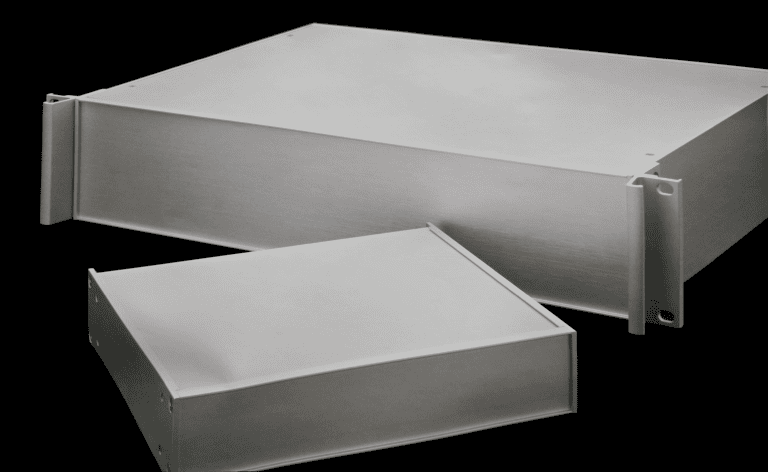
Modular enclosure platforms address this by establishing a standardized enclosure architecture that supports multiple machine configurations.
Rather than designing a new enclosure for each variant, engineers work within a consistent structural framework that can be adapted internally. Common characteristics of modular enclosures include:
- standardized frame structures
- interchangeable panels and covers
- configurable mounting systems
- predictable internal clearances
- scalable I/O and cable management layouts
Because the enclosure architecture remains consistent, internal configurations can be adjusted without redesigning the enclosure itself.
This approach aligns with modular engineering principles used in manufacturing systems, where standardized platforms allow products to evolve while preserving core infrastructure. Research on modular design consistently shows reduced engineering complexity and improved development efficiency.
For machinery OEMs managing multiple machine models, modular enclosures provide a stable mechanical foundation that supports long-term platform scalability.
Expanding a Machine Platform Without Enclosure Redesign
Consider a typical machine development scenario.
An OEM launches a base machine designed for a specific industrial application. As the product gains traction, customers begin requesting additional configurations:
- a higher-capacity system with expanded controls
- a compact version for space-constrained facilities
- a configuration integrating additional monitoring sensors
If the enclosure is custom-fabricated, each new variant may require:
- revised enclosure drawings
- new mounting layouts
- updated wiring and cable routing paths
- additional procurement coordination
Even when the core machine architecture remains unchanged, enclosure redesign can slow development timelines. With modular enclosures, the structural enclosure platform remains unchanged.
Engineers can reuse the same enclosure architecture across machine variants while adapting internal configurations.
Control boards can be repositioned, panel layouts modified, and additional interfaces integrated without rebuilding the enclosure itself. In this scenario, modular enclosures eliminate repeated enclosure redesign, significantly reducing rebuild time as machine platforms expand.
Repeatability Across Engineering, Documentation, and Procurement
Beyond reducing rebuild time, modular enclosure platforms introduce repeatability across development workflows.
When enclosure architectures remain consistent:
- engineering documentation becomes easier to maintain
- procurement teams can standardize sourcing
- manufacturing workflows become more predictable
- enclosure fabrication variability is reduced
This repeatability allows teams to move from design to production without reworking enclosure configurations for each variant.
It becomes especially valuable as machines transition from pilot builds to full production, where enclosure-related delays can impact manufacturing schedules.
Scaling Machine Platforms Without Slowing Development
As machinery OEMs expand product lines and introduce new variants, enclosure architecture plays a critical role in how efficiently those systems evolve.
By adopting modular enclosures as a foundation for control system infrastructure, engineering teams gain a repeatable platform that supports scalability without repeated mechanical redesign. Reducing enclosure-driven rebuild time allows OEM teams to scale machine platforms without slowing development cycles—resulting in faster variant development, fewer fabrication changes, and more predictable manufacturing timelines.
To fully realize these benefits, engineering teams also need efficient ways to translate system requirements into production-ready enclosure configurations. Tools that connect requirements directly to enclosure solutions help eliminate manual iteration and reduce delays during design and procurement.
Lansing Instrument supports this workflow through in-house manufacturing and direct sales model, offering modular enclosures manufactured in the United States alongside tools that help engineers move from concept to configuration more efficiently. OEM teams can explore enclosure options and generate configurations using Lansing’s instant pricing enclosure builder tool, which provides part numbers and MSRP for faster, more informed decision-making.For OEM machine builders evaluating enclosure strategies, modular platforms from Lansing provide a practical path to scalable system design. Explore solutions aligned with your next machine platform.