
Product Page Title
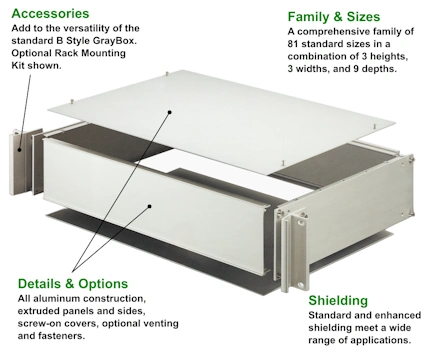
Product Features
Lorem ipsum dolor sit amet, consectetur adipiscing elit. Ut elit tellus, luctus nec ullamcorper mattis, pulvinar dapibus leo.
Product Variations

Menu Item
Menu Item
Menu Item
Product Price
Menu Item
Product Specifications
Lorem ipsum dolor sit amet, consectetur adipiscing elit. Ut elit tellus, luctus nec ullamcorper mattis, pulvinar dapibus leo.
Accessories
-
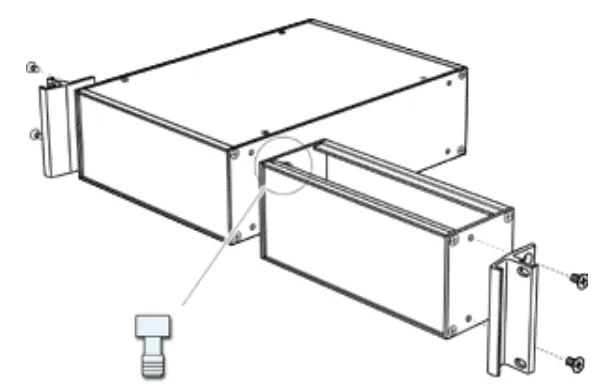
Coupling Screws
-
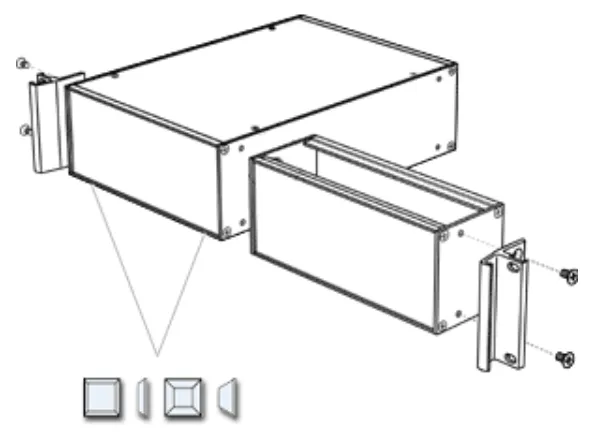
Non-skid Feet
-
Rack Mount Panels for MicroPak Enclosures
-
Corrosion-Resistant Enclosures: Anodized vs. Iridite Coatings
Aluminum provides a strong, lightweight foundation for electronic enclosures and the surface finish can affect how the enclosure performs in its operating environment. For corrosion resistant enclosures, two common electronic enclosure finishing options are anodizing and iridite coating. Both provide corrosion protection, but they offer different surface characteristics that can influence enclosure design. The right choice…
-
Building Telecom & Data Center Equipment on Proven Rackmount Enclosure Platforms
Telecommunications infrastructure, networking equipment, and data center technologies continue to evolve rapidly, but one requirement remains consistent: electronic equipment must integrate reliably into standardized 19 inch rack environments. As electronics become more specialized, engineers are challenged with delivering application specific functionality while maintaining manufacturability, repeatability, and long-term product reliability. Although designing a completely custom enclosure for…
-
Aluminum PCB Enclosures Improve Compact System Design in Telecommunications and Data Centers
Telecommunications networks and data centers rely on far more than servers, switches, and rackmounted infrastructure. Behind the scenes, a wide range of monitoring systems, communications interfaces, power management devices, environmental sensors, and control electronics support the operation of these environments and require compact, reliable protection. That’s where PCB enclosure design comes into consideration. Many of…
-
How Aluminum Enclosures Manage Heat Dissipation and Signal Stability in Power Systems
Modern power systems inherently generate heat and electromagnetic noise through high frequency switching, power conversion, and continuous operation. As system density increases, thermal and electromagnetic effects become tightly coupled, directly influencing temperature stability, signal integrity, and overall system reliability. These interactions are no longer secondary considerations. They define system performance under load. The enclosure establishes…
-
Managing EMI in High-Performance Electronics for Power and Timing Systems
High-performance electronics used in power delivery and timing systems operate in demanding environments where electromagnetic compatibility margins are increasingly constrained. As switching frequencies rise and system architectures become denser, EMI performance becomes increasingly dependent on enclosure design for maintaining signal integrity, timing stability, and power system reliability. A well-engineered EMI shielded enclosure is a defining factor in…
-
PCB Enclosure Design That Survives Verification, Validation, and Clinical Use
Medical device development is often driven by electronics performance, leading many teams to design the printed circuit board (PCB) first and address the enclosure later. While this approach may accelerate early prototyping, it introduces risk as products move toward verification, validation, regulatory testing, and clinical use. PCB enclosures are more than protective housings; they define…
-
How Machinery OEMs Cut Rebuild Time with Modular Enclosure Platforms
Machinery OEMs operate in a constant cycle of refinement. A machine platform that begins as a single configuration often evolves into multiple variants as new customer requirements emerge. Control layouts change, I/O requirements expand, power density increases, and new sensors or subsystems are integrated. While these changes expand product capabilities, they often expose a persistent…
-
Designing a Scalable Control Panel Enclosure for Manufacturing and Automation Systems
Control panels are rarely one-and-done. In manufacturing and automation environments, systems expand as throughput increases, processes change, or new equipment is added. When a control panel enclosure is designed as a fixed, one-off build, every change introduces friction: redesigning, fabrication delays, QA risk, and downtime. Modular enclosure platforms solve this problem by giving engineers a repeatable foundation…
-
The Benefits of Enclosure Production Repeatability
Many hardware engineering teams face a common dilemma: the need to create custom electronic prototype enclosures quickly, while still building something that won’t potentially require a complete redesign when production begins. Too often, teams find themselves trapped in a cycle where each product iteration forces them back to square one with their enclosure. Before long,…
-
From Specification to Reality: Why OEMs Benefit from Enclosures Engineered to Meet NEMA & IP Ratings
When OEMs begin planning for environmental protection, the conversation often starts with NEMA and IP ratings such as “We need IP67.” “We need a NEMA 4X enclosure.” These ratings serve as helpful benchmarks, but they describe only the required protection level, not how to design or build an enclosure that achieves performance in actual operating conditions. Products…