
Many hardware engineering teams face a common dilemma: the need to create custom electronic prototype enclosures quickly, while still building something that won’t potentially require a complete redesign when production begins. Too often, teams find themselves trapped in a cycle where each product iteration forces them back to square one with their enclosure. Before long, what should have been a quick update turns into additional weeks of new designs and additional configuring.
This is more than an inconvenience. It becomes a serious barrier to scaling. When enclosure architecture changes with each revision, teams lose the ability to standardize, test, and move confidently into production. Launch timelines slip, costs climb, and engineering momentum stalls.
Research indicates that approximately 70% of a product’s total manufacturing costs, including material, processing, and assembly costs, are influenced by design decisions. Thus, the more changes, the higher the costs.
Thankfully, there’s a simple solution: Develop products using modular electronic enclosures.
Prototyping Pitfalls When Scaling
Consider a common scenario. An engineering team needs to prototype an electronic enclosure quickly, knowing it will eventually support multiple product variants. They build an initial prototype that meets early requirements and performs well in testing.
As feedback comes in, the design evolves. New features are added, dimensions shift, and additional variants are introduced. Suddenly, the team is redesigning the housing, adjusting layouts, resubmitting drawings to the enclosure manufacturer, and reordering parts.
What began as a straightforward prototype effort becomes a growing enclosure project with expanding scope. Each iteration extends the timeline and increases cost.
The issue is rarely not the electronics themselves. The real challenge is the lack of a repeatable structural framework that allows designs to evolve without starting over. Without that foundation, even small changes create outsized delays.
The Fix: Modular, Repeatable Enclosure Production
An adaptable enclosure family, such as Lansing’s modular designs, solves the problems of prototype scaling and variants by separating what must remain constant from what needs to change. Instead of redesigning the entire housing, engineer can retain 80-90% of a proven enclosure design while modifying only the elements that truly need to change such as panels, interfaces, and mounting configurations.
The benefit is that the core enclosure remains consistent from prototype to production, while custom elements, such as panels, enhanced shielding, and additional components, can adapt to each product variant’s prototype.
By starting with a modular enclosure, each custom electronic prototype enclosure variant can be updated, rearranged, simplified, or scaled up more quickly than with traditional prototype manufacturing, and at significantly lower cost. Development cycles that took months can be shortened to weeks. Teams are no longer waiting for new tooling or full enclosure redesigns.
Just as important, every prototype built on a modular foundation is already production ready. There is no last-minute redesign when it is time to scale.
In practical terms, modular electronic enclosures allow teams to move faster, spend less, and adapt confidently as designs evolve. This approach allows engineering teams to stay focused on electronics and system performance, while Lansing handles enclosure design, manufacturing, finishing, and kitting, reducing friction and accelerating time to market.
Lansing’s Modular Platforms: From Prototype to Production
Lansing has built its adaptable enclosure strategy around this principle of repeatability. Our modular enclosures provide engineering teams with a production-ready foundation from day one, offering the flexibility to iterate quickly during development.
For Rackmount Enclosures and Industrial Applications:
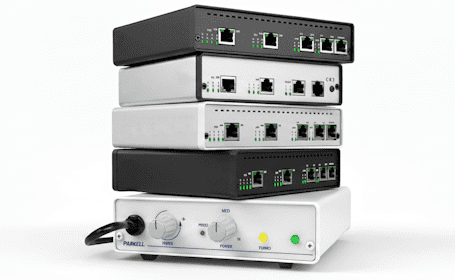
Our GrayBox designs provide a rigid aluminum frame available in 81 standard sizes. The interchangeable panel system enables teams to prototype standard components and easily swap in custom panels as designs evolve. When it’s time to scale, the same core frame supports every unit across the product line, ensuring mechanical consistency and simplifying assembly.
For Compact or Handheld Products:
MicroPak offers an 18-size tube-based design that seals cleanly, easily mounts printed circuit boards (PCBs), and delivers a refined appearance. These enclosures provide enhanced versatility and configurability, all while maintaining quality and repeatability.
Both platforms minimize the number of parts needed and reduce the complexity that typically slows enclosure development. The result is a repeatable, production-ready enclosure path for your products.
Prove your enclosure once and replicate it reliably across every unit. Browse Lansing’s modular enclosures to find the best fit for your next project or connect with the support team to discuss your requirements and get a quote today.