
Aluminum electronic enclosure design often requires engineers to balance application-specific requirements with practical considerations around manufacturing, structural performance, and product presentation. PCB dimensions, component placement, connectors, access points, and overall enclosure size can all influence the final design. The challenge in extruded aluminum enclosure design is finding a construction method that accommodates those requirements without creating unnecessary engineering effort, manufacturing complexity, or cost. At the same time, the enclosure must provide the durability, appearance, and brand identity expected of the finished product.
Rather than designing a completely custom enclosure for each new electronic assembly, engineers can use extruded aluminum to establish a configurable enclosure foundation. This approach provides a repeatable structural platform that can be adapted through length, panel configuration, machining, mounting features, and finishes.
Extruded Aluminum Enclosure Design Starts With the Assembly
Effective extruded aluminum design begins with the requirements of the electronic assembly. PCB dimensions, component heights, connector locations, cable routing, service access, and available space establish the physical constraints the enclosure must accommodate.
A completely custom enclosure can address these requirements, but it may also increase development time and engineering effort. An extrusion-based approach allows engineers to standardize the underlying enclosure structure while customizing the features that directly affect the application.
This balance is particularly useful when product configurations vary or when an electronic assembly may evolve during development.
Key Considerations in Extruded Aluminum Enclosure Design
The extrusion profile becomes part of the enclosure’s structural and functional architecture, allowing engineers to address several design considerations without starting from scratch.
Accommodate Different Enclosure Lengths
Because aluminum extrusion is manufactured as a continuous profile that can be cut to length, enclosure length can be adapted to the PCB and internal components without redesigning the entire enclosure structure. Engineers can work from established aluminum extrusion dimensions and adjust enclosure length to suit the application.
This approach can support multiple product configurations while maintaining a consistent enclosure profile.
Integrate PCB Mounting Into the Extrusion
Internal features can be incorporated into the extrusion profile to provide tracks or mounting provisions for PCBs. This helps establish a repeatable relationship between the circuit board and enclosure while simplifying assembly and component integration.
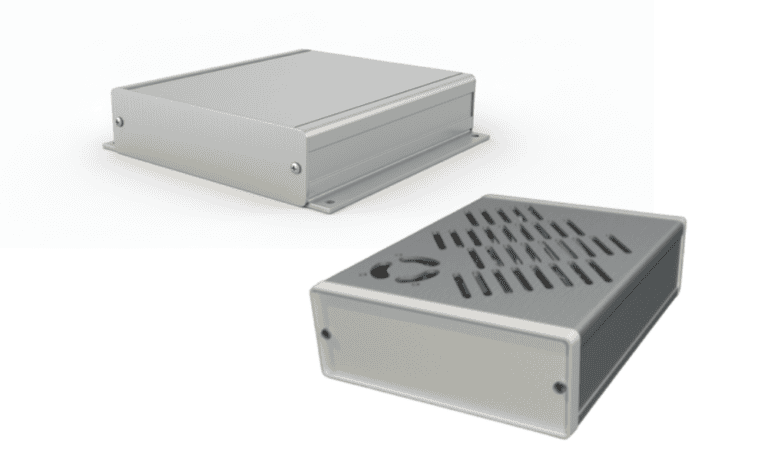
Lansing’s MicroPak enclosure designs, for example, incorporate internal features for PCB mounting and are available in multiple standard configurations.
Maintain a Rigid Yet Lightweight Structure
A continuous extruded aluminum enclosure body provides a rigid yet lightweight structure for protecting and supporting internal electronics. Consistent profile geometry also helps maintain dimensional characteristics across different enclosure configurations.
For applications requiring variations in size or configuration, this structural consistency can simplify both design and production while maintaining a professional finished enclosure.
Simplify Access and External Interfaces
End panels provide another opportunity for application-specific customization. Panels can be configured or machined for connectors, displays, switches, ventilation, cable entry, and other interfaces without requiring the entire enclosure body to be redesigned.
This separation between the structural extrusion and configurable panels allows engineers to modify the external interface while retaining the underlying enclosure platform.
Address EMI/RFI Shielding Requirements
Aluminum can also provide inherent electromagnetic shielding characteristics, making it an important consideration for applications where EMI/RFI performance is part of the enclosure design. Equipment subject to FCC Part 15 requirements may require particular attention to electromagnetic compatibility and emissions.
Applications such as medical and laboratory instrumentation, aerospace and defense systems, industrial controls, and communications equipment can operate in environments where signal integrity and electromagnetic interference require careful consideration. Enclosure geometry, seams, fasteners, openings, grounding, and other design details should be evaluated alongside the material itself to achieve the required shielding performance.
Customize Finishes for Durability and Product Appearance
Enclosure design also affects how a finished electronic product is perceived. Coatings and finishes can provide durability while contributing to a professional appearance and consistent brand identity.
Depending on the application, aluminum enclosures can be specified with finishes such as anodizing or chromate conversion coatings. MIL-A-8625F Type II anodizing provides a durable oxide layer with increased hardness and abrasion resistance. Iridite, or chromate conversion coating specified to MIL-DTL-5541F, can provide corrosion resistance while supporting applications where electrical conductivity and finish requirements must be considered.
These options allow engineers to account for both functional and aesthetic requirements within the enclosure design.
Extruded Aluminum Enclosure Design Balances Standardization and Customization
One of the primary advantages of aluminum enclosure extrusion design is the ability to use a standardized structural foundation without limiting application-specific requirements.
Rather than treating every electronic product as a completely custom enclosure project, engineers can start with an established extrusion platform and customize the elements that directly affect the application. Length, panels, machining, mounting provisions, finishes, and interfaces can be adapted while the underlying enclosure architecture remains consistent.
Once the extrusion profile and configuration are established, that structure can also be reproduced consistently across production runs. This supports repeatable manufacturing while retaining the flexibility needed for different electronic assemblies.
The Value of a Configurable Extruded Aluminum Enclosure Design
A well-planned extruded aluminum enclosure design can help engineers reduce enclosure development effort while accommodating application-specific electronics. It can simplify PCB integration, maintain consistent structural dimensions, support EMI/RFI considerations, and provide flexibility for connectors, access points, mounting features, and finishes.
The result is a practical middle ground between a completely standardized enclosure and a fully custom design. Engineers can leverage an established enclosure platform while modifying the features that matter to the application, helping balance customization with manufacturability, production efficiency, durability, and product presentation.
Lansing Instrument offers a range of aluminum electronic enclosures that provide this combination of established enclosure platforms and configurable design options. Explore Lansing’s aluminum electronic enclosures to identify an enclosure foundation that can be configured around the requirements of the next electronic application.